Trust
Every version manifest the origin hands out is signed with Ed25519, and nodes and mirrors pass the signature through unchanged. You pin the origin's keys once, where you trust the origin, and check a manifest from anywhere against them. The SDK follows key rotations through endorsements and refuses revoked keys.
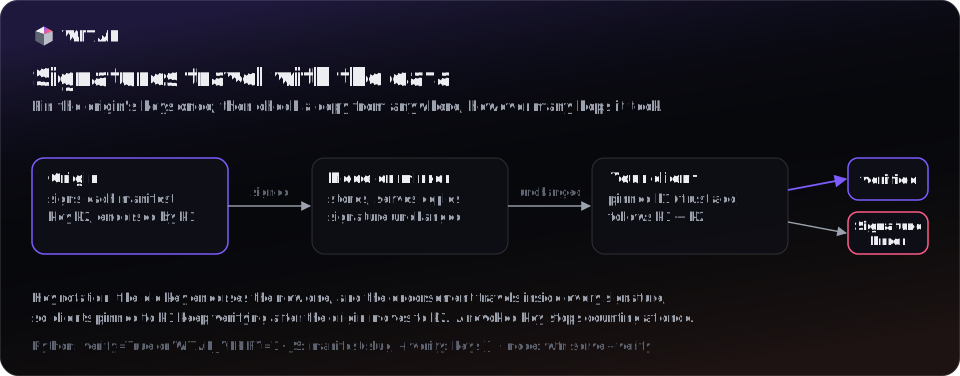
Pin the origin's keys
keys() reads the keys the origin signs with, from /.well-known/witan-keys. It needs no API key. It returns a SigningKeys object: origin, keys (each with kid, alg: "Ed25519", publicKey in base64, and status: "current", "retired" or "revoked") and endorsements.
import { Witan } from "witan-sdk";

const origin = new Witan({ baseUrl: "https://witan.markets" });   // the origin you trust
const pinned = await origin.keys();
console.log(JSON.stringify(pinned));   // store this with your agent's config
Do this once, from a place you trust, and store the JSON. Keys fetched next to every manifest, from the same server, would only check that server against itself.
Verify a manifest
Pass the pinned keys to projects.manifest as verify, and the signature is checked before the manifest is returned. The manifest can come from the origin, a node or a mirror:
const node = new Witan({ baseUrl: "http://127.0.0.1:8686", apiKey: "node" });
const m = await node.projects.manifest("agent-api-observatory", { verify: pinned });   // an origin version, served by a node
For a manifest you already hold, call verifyManifest(manifest, keys, { require }). It resolves "verified", or "unsigned" when the manifest carries no signature. Versions written on a node are the node's own and unsigned. With require: true an unsigned manifest throws; projects.manifest with verify always requires a signature.
import { SignatureError, verifyManifest } from "witan-sdk";

try {
  const result = await verifyManifest(m, pinned);   // "verified" | "unsigned"
} catch (e) {
  if (e instanceof SignatureError) console.error("refused:", e.message);
  else throw e;
}
Both throw SignatureError when the manifest:
- is signed for another origin than the pinned keys'
origin; - uses an algorithm other than Ed25519;
- is signed with a key the pinned set marks
"revoked"; - is signed with a key that is not pinned and that no endorsement in the signature leads to from a pinned key;
- carries an endorsement that is malformed or does not verify;
- does not match its signature: the manifest was altered or corrupted.
What the signature covers
signedStatement(manifest, origin) returns the exact string the origin signs: { v: 1, origin, manifest } as JSON with sorted keys and no whitespace. The manifest in it leaves out signature, urlExpiresAt, paid and each part's url. A manifest with fresh download URLs from any mirror therefore still verifies, while the version, totals, schema and each part's sha256, records and bytes are covered.
The SDK does not download parts. When you do, check each one against its sha256:
async function sha256Hex(data: ArrayBuffer): Promise<string> {
  const digest = new Uint8Array(await crypto.subtle.digest("SHA-256", data));
  return [...digest].map((b) => b.toString(16).padStart(2, "0")).join("");
}

for (const part of m.parts) {
  const bytes = await (await fetch(part.url)).arrayBuffer();   // valid until m.urlExpiresAt
  if ((await sha256Hex(bytes)) !== part.sha256) throw new Error(`part ${part.sha256} does not match`);
}
Key rotation
When the origin rotates its key, the old key endorses the new one. An endorsement is the old key's signature over endorsementStatement(origin, newKey), and every signature carries the links from earlier keys to its key as chain, oldest first. verifyManifest walks that chain from your pinned keys, so a rotation needs no change on your side. A revoked key vouches for nothing.
To refresh the stored keys, apply a fresh keys() document with updatePinnedKeys(pinned, published, { force }). It does not trust the document blindly:
| Result field | What it lists |
|---|---|
keys |
The new pinned set. Store it in place of the old one. |
added |
Keys a pinned key endorsed, directly or through a chain. |
revoked |
Pinned keys the origin newly marks revoked; they stay in keys with status: "revoked". |
refused |
Published keys no pinned key leads to. They are not added. |
import { updatePinnedKeys } from "witan-sdk";

const { keys: next, added, refused, revoked } = await updatePinnedKeys(pinned, await origin.keys());
console.log(`added: ${added.join(", ") || "none"}; revoked: ${revoked.join(", ") || "none"}`);
if (refused.length) console.warn(`keys without an endorsement: ${refused.join(", ")}`);
// store `next` in place of `pinned`
A non-empty refused means the origin re-keyed without an endorsement, for example after a leaked key. Check the key ids with the origin's operator, then call updatePinnedKeys(pinned, published, { force: true }) to add them. Even then, a key whose kid is not derived from its public key throws SignatureError, and so does a document for another origin.
Pinned keys in a serverless function
A SigningKeys object is plain JSON, so store it where the function reads its configuration. The SDK reads no variable for it; the names below are your own.
- An environment variable or secret. Read-only at run time; you refresh it by redeploying.
const pinned = JSON.parse(process.env.WITAN_PINNED_KEYS!) as SigningKeys; - A key-value store (Cloudflare KV, or your platform's equivalent). The function can then refresh the keys itself on a schedule.
import { Witan, updatePinnedKeys, type SigningKeys } from "witan-sdk";

interface Env { WITAN_BASE_URL: string; WITAN_API_KEY: string; TRUST: KVNamespace }

export default {
  async fetch(_request: Request, env: Env): Promise<Response> {
    const pinned = await env.TRUST.get<SigningKeys>("pinned-keys", "json");
    if (!pinned) return new Response("no pinned keys", { status: 500 });
    const w = new Witan({ baseUrl: env.WITAN_BASE_URL, apiKey: env.WITAN_API_KEY });
    const m = await w.projects.manifest("agent-api-observatory", { verify: pinned });
    return Response.json({ version: m.version, records: m.totals.records });
  },
  async scheduled(_controller: ScheduledController, env: Env): Promise<void> {
    const pinned = await env.TRUST.get<SigningKeys>("pinned-keys", "json");
    if (!pinned) return;
    const r = await updatePinnedKeys(pinned, await new Witan({ baseUrl: env.WITAN_BASE_URL }).keys());
    if (r.added.length || r.revoked.length) await env.TRUST.put("pinned-keys", JSON.stringify(r.keys));
    if (r.refused.length) console.warn("refused keys:", r.refused);
  },
};
Seed the store once with the JSON from keys(), fetched where you trust the origin. Never pass force: true from a scheduled job.
WebCrypto Ed25519 by runtime
Verification uses the runtime's WebCrypto (crypto.subtle) with Ed25519.
| Runtime | Verification |
|---|---|
| Node.js 22 and later | yes |
| Deno, Bun, Cloudflare Workers | yes |
| Vercel and Netlify functions | as the Node version they run |
Where crypto.subtle is missing or cannot import Ed25519 keys, checking a signature or an endorsement throws a WitanError with status 0 that says so. projects.manifest without verify works everywhere. Every function and type is in the API reference.